
WSO Musicians/ Orchestra Members
Having a symphony orchestra in a relatively small Canadian city such as Windsor has been a boon to local musicians, and Windsor is fortunate to have a nexus of talented people from the area and abroad who play in the Windsor Symphony Orchestra. Many of the early orchestra members who had a day job elsewhere played with an orchestra just for the chance to play in a larger group. Whether the musicians play full-time or in the past as part-time members, the musicians of the WSO have demonstrated extraordinary dedication.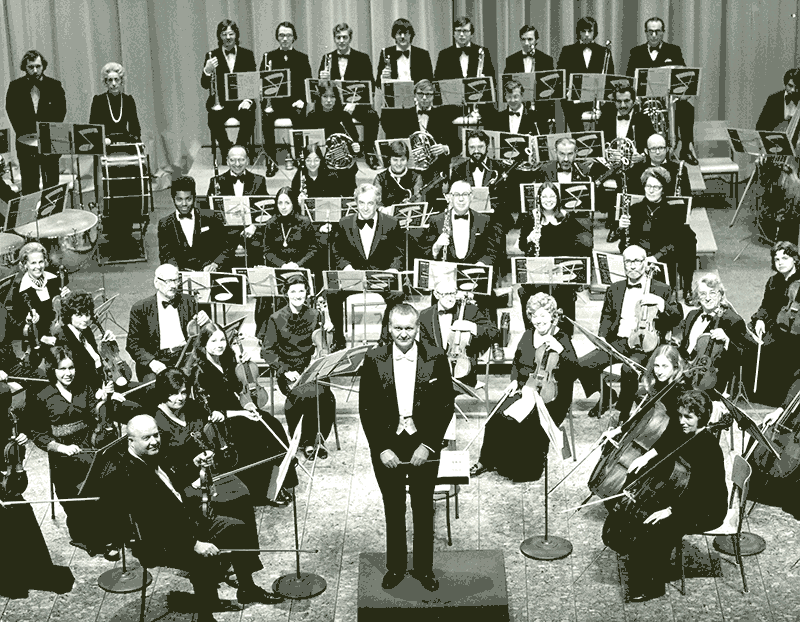
Common attributes of WSO musicians through the years never seem to have changed: all have studied their chosen instruments for years; none is paid as highly as the hours of practice and performance represent, and because of this, most seek more than one source of income. Many WSO musicians are also instructors at the University of Windsor or other educational institutions, and most teach music to private students. Many travel to other cities such as Detroit and Toronto for extra opportunities to play.
In the 1940s, orchestra musicians even performed more than one volunteer job to keep the orchestra going, including fundraising and administrative work promoting and organizing concerts. A December, 1940 concert programme shows for example, Mrs. Claire Balman, the concert pianist and percussionist with the orchestra was also the Vice-President, and a young violinist and occasional soloist Anna Gulak Grayson was the Social Convener, organizing the calendar of events. WSO musicians often played for decades with the orchestra. As a young student, Anna Gulak (who lived across the road from Matti Holli) was the featured soloist in a May, 1939 concert. As Anna Grayson, she became an elementary music teacher in Essex County and played with the WSO until the 1980s.
The WSO’s first concerts were held on Sunday nights – this was likely because most musicians played in jazz and pop ensembles at Windsor’s famed dance venues such as the Top Hat and the Elmwood, with top performers such as Tony Bennett, Frankie Lane and Paul Anka. Many musicians had a regular income playing live on local radio broadcasts. Renowned local musician and sheet music store owner Celia Hardcastle suggested that Maestro Holli was “having some difficulty getting solo performers (especially the “free” performance ones). There was no money, so eventually he got around to asking me to solo at a performance. A freebie!” (Hardcastle, 1995, p.18).
In the early days, Holli recruited local musicians and students that he knew to play in the orchestra as it was a great opportunity to gain experience in one’s music career. Now auditions are performed blind, where musicians perform behind a screen for the hiring committee, to ensure fairness in hiring.
About 45 musicians played with the WSO through the 1950s. By the 1970s, the number had grown to 65. The only full-time players were the concertmaster, principal second violin, viola and cello players.
In the 1970s, WSO muscians were rehearsing twice a week and three times every second week in various locations, including the Shaar Hashomayim Synagogue, and sometimes at the Cleary auditorium. The local media has not always been supportive of the quality of WSO musicians: “the violins appeared a little ragged” said Spiros de Bono (Windsor Daily Star, October 30, 1967); “A note of caution – the WSO’s brass section is a strong point, When they are at their best, and the strings are only mediocre, the balance is easily lost,” mused Ken Caunce, but also gave praise: “The percussionists deserved the plaudits here.” (Windsor Daily Star, October 26, 1968). However, enthusiastic audiences came to concerts, with numbers reaching 1000 even in 1949 at the Tivoli.
Under Dwight Bennett in the late 1980’s all musicians were fully professional, with 10 core players doubling to 20 and often 25 more were employed. There was a brief downturn when financial challenges forced the WSO to cut salaries and the musicians, all members of the Windsor Federation of Musicians were forced to go on a brief strike. Ultimately, most of the musicians chose to stay with the orchestra. The average musicians’ salary in the late 1980s was $20,000.
WSO musicians also perform all through the week and in the evenings in smaller groups around the city and county. Some of the dangers are carrying heavy instruments, playing in cold (or too hot) venues through all seasons. Some dangers are not so obvious: in 1984, Robert McPherson, then the Chair of Musicians Relations with the Board begged the funders on behalf of the cello section to provide chairs from the WSO for off-site concerts, otherwise chairs provided by other venues could be uncomfortable if not dangerous!
The WSO musicians remain a tight-knit supportive group. A few have met their spouses at orchestra rehearsals. Most often, WSO musicians offer support to each other, and the community often plays a role. Harpist Leda Maria Pap arrived in Windsor from her native Hungary, but could not afford to buy her own harp. In some European orchestras, such an instrument is owned by the orchestra, not the musician. The local Hungarian community arranged fundraisers and helped Pap buy her own harp, which helped her to increase her income with extra concerts.
Concertmasters
A concertmaster (the title remains the same even if a woman holds the post) has a vital role in the orchestra. At concerts, they enter before the conductor, and having tuned their violin offstage, will lead the musicians in the correct tuning for the concert. Behind the scenes, it is their job to insert the bowing marks in the musical scores to be played. These are indications of the up and down movement of the violin’s bows in order for the violin section to perform as a cohesive whole. The concertmaster may then rehearse with the string section in order to make sure that the bowing marks are effective, and discuss the details with the conductor to ensure a united interpretation of the composer’s work.
The post of concertmaster has been a permanent full-time role with the WSO. Mr. W. McCabe was the WSO’s earliest concertmaster in 1939. Lasse Pohjola served with the WSO for decades until his death in 1976, and then the first auditions for the role were held, with the salary beginning at $8,000 per year.
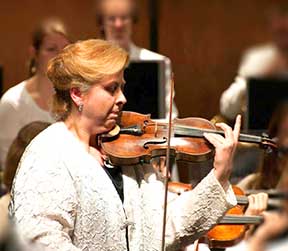 The current concert master is Lillian Scheirich, who joined the WSO in 1989 and was appointed assistant concertmaster in 1991. She is also an accomplished violin soloist and teacher. She helped to found the Ambassador Chamber Players, and plays with La Corda Ensemble and the Detroit-Windsor Chamber Ensemble.
Windsor Symphony Chorus
Throughout its history, the Windsor Symphony Orchestra has partnered with local choirs and performed choral music both at pops and classics concerts.
In the 1970s, the orchestra gave annual concerts with the Leamington Choral Society. Choir director Helen Law founded that choir in 1960, and it was also known as the Helen Law Singers.
Musician and university Professor Richard Householder established the Windsor Classic Chorale comprising 32 singers in 1977. From 1988, Householder directed the Windsor Symphony Chorus 80 to 100 voices, which is now directed by Joel Tranquilla.
These choirs and various others including the Elmer Iseler Singers, school and university choirs have all joined the WSO on programs that vary from Christmas pops, Handel’s Messiah, and Haydn’s Requiem.
Most choir members live in this area, and many belong to more than one choir. In 1999, a reviewer raved about the choirs’ unity of performance, and the measure of enjoyment, not only for the audience, but for the singers themselves, who value the experience. Margaret Kapasi, the chorus master for the evening described the singers as they performed: “You could see the joy on them” (Windsor Star, April 10, 1999).
Guest Artists
Guest musicians and artists who perform with the WSO include many talented Windsor-based musicians and vocalists. Some debuted with the WSO and went on to successful solo and teaching careers overseas and across North America. Some came from abroad and were embraced by the local cultural community. Many flourished under the nurturing of colleagues at the WSO, the proximity to a high-quality orchestra and exposure to appreciative audiences.
Catherine McKeever (1952 – 2012) was a favourite guest of the WSO, and her career is an example of the educational and professional opportunities afforded by the orchestra. McKeever’s talent was recognised and encouraged by former conductor Susan Haig, and McKeever resolved to further her music education at the University of Windsor. Detroit-born Windsor resident McKeever was a popular vocal soloist for the WSO and Windsor Classic Chorale’s performances of Bach choral pieces and Handel’s Messiah. She died during the writing of this project, at age 60. We dedicate this section to Catherine McKeever and her legacy as an artist and teacher. The list of guest artists is too long to enumerate here, but a brief sampling demonstrates the breadth and quality of talent that has visited the stages in Windsor.
Local musicians may have been the less-expensive option for the cash-strapped Maestro Holli, but the WSO can take credit for acting as a proving ground for: Claire Balman, pianist – debuted with the WSO at age 19 to rave reviews in the 1940s; Anita Leshcheid, harpist; Margaret Kapasi, pianist; and Alexander Zonjic, flutist.
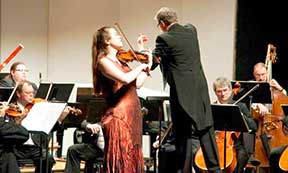 Debuts of more careers launched from the WSO: Adele Armin, violinist, worked with avant-garde artists and music and the great Glenn Gould; Lara and Scott St. John, brother and sister violinists who as children debuted with the WSO, and returned as adults. Lara now has a successful recording career with her own recording company, and Scott teaches at Stanford and plays with the St. Lawrence String Quartet; and Adrienne Shannon, pianist, now with Queen’s University School of Music.
Canadian musicians have been welcomed to the WSO. Windsor is at the border with the USA, so Canadian culture can be overwhelmed by American media. The WSO has been proudly promoting artists from all over Canada. Others included Gordon Fleming, a composer and concert pianist from Goderich, ON, was also staff organist at Windsor’s CBC station; Russell and Victor Braun, father and son vocalists; and Erika Raum, violinist.
Choirs are integral to many musical programmes such as Handel’s Messiah and Beethoven’s Ninth Symphony. Helen Law Singers and the Leamington Choral Society were frequent guests; the University Singers; University Chamber Choir; and Windsor Symphony Chorus.
Classical Stars who visit the WSO are a measure of how highly regarded is the orchestra nationally and internationally, including: Anton Kuerti, Austrian-born naturalized Canadaian pianist, composer and conductor; Maureen Forster, contralto; Canadian Brass, wind ensemble; and Quartetto Gelato, a chamber ensemble featuring Windsor native George Meanwell.
Pop, Rock, Country and Jazz stars bring newcomers to the orchestral experience: Salome Bey, singer, songwriter; Rita MacNeil, singer, songwriter; Jody Raffoul, singer, musician; Shahida Nurulla, jazz vocalist; Sultans of String; and Joe Coughlin, jazz singer.
Local media representatives have also graced the stage, often to narrate Peter and the Wolf: the late broadcaster Sonny Eliot; CTV anchor Jim Crichton; as has Stratford actor Colm Feore on a CD recording; and Windsor Star journalist Ted Shaw has played the laptop with the WSO at a pops concert with John Morris Russell.
Comedy, proof if ever needed, that classical music has a sense of humour has been an integral part of the pops concerts. The WSO has played “straight man” for Victor Borge, pianist; the Royal Canadian Air Farce, satire comedy group from CBC; and Steve Smith, better known as Red Green.
Sports stars have also been welcomed to the stage, including Windsor boxers Jeannine Garside and Mary Spencer.
Composers
It may be a surprise to learn that the Windsor Symphony Orchestra (WSO) is cutting edge in its support of new music and young – still living! – composers. Every conductor in the WSO’s history has sought out music by Canadian composers, many of whom have collaborated with the orchestra to premiere their works in Windsor.
Susan Haig introduced the first Windsor Canadian Music Festival in January, 1997. Because of Haig’s reputation for outreach, Windsor was chosen for a “Words and Music” themed festival. After that, the Windsor Canadian Music Festival became an annual event: a collaboration between Canadian composers, Canadian poets during some years, the School of Music at the University of Windsor and the WSO.
In 1997, the WSO’s first composer-in-residence, Jeffrey Ryan, took part in educational events, visited schools, and conducted workshops with local musicians and composers.
Innovative approaches to classical music such as electronica was another feature in 2006. The orchestra plays more than the well-known 150-year-old “standards” – it has also featured new technology for making music. The New Canadian Music Festival has featured performances by the University’s Noiseboarder ensemble.
Brent Lee was composer-in-residence from 2003 – 2006 and is still involved with the WSO from his role with the School of Music in the University of Windsor. Lee composed special children’s music for “Last Minute Lulu” with words by local author Christopher Paul Curtis for the Juno-nominated CD recording of “Peter and the Wolf and Last Minute Lulu” with the WSO.
With a nod to this area’s rich history, Lee was commissioned by the WSO to write a piece commemorating the Bicentennial of the War of 1812, with a piece called “General Brock in Detroit,” which premiered at an outdoor concert at Windsor’s Riverfront on August 25, 2012. This concert also featured a young Windsor composer: a recent graduate from Walkerville Centre for the Creative Arts in Windsor, Eric Swiatoschik.
Peter Wiebe, with the WSO, has also arranged and composed several pieces of music for the WSO, the Windsor Symphony Youth Orchestra, the Windsor Community Orchestra and children’s Peanut Butter & Jam concerts. Here in this video, he explains the background of the “Comeback Symphonietta.”