
WSO Maestri/ Conductors
Maestri/ Conductors
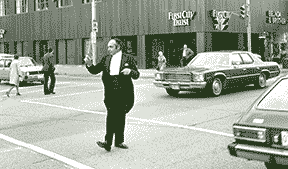 A conductor of a modern orchestra is a true multi-tasker. One has to be a good leader, educator, fund-raiser, entertainer and most of all, a well-rounded musician. If the position is a combination of a conductor and music director, then the person must also take on the tasks of planning and programming the orchestra’s annual season and overseeing the educational component of the orchestra’s structure. The Windsor Symphony Orchestra has been fortunate in its roster of passionate individuals who have nurtured the ensemble through the years. Pioneering conductors in Windsor deserve mention, although they predate the incorporation of the Windsor Symphony Orchestra.
H. Whorlow Bull, (ca 1920-1930)
Born in England, Whorlow Bull (1872-1938) was a devotee of choral and orchestral music in Windsor. He was a conductor and the music supervisor of the Public School Board in the 1920s. He conducted early concerts, especially for the Windsor and Walkerville Choral Society who performed with organ and small orchestras. An early WSO concert in February of 1939 was a memorial to him.
Frederick G. Vallance (ca 1920-1930)
An English-born musician and violin maker, Fred Vallance (dates unknown) immigrated to Detroit, MI. According to contemporary accounts, “Mr. Vallance because of his experience in British orchestras of national fame, has been of great assistance in starting the Windsor group off on the right foot and advising his younger colleague [Peter C. Allan]” (Munro, February 10, 1939). Vallance-made violins and bows are still used today and some are sold in vintage musical instrument auctions. Vallance is listed as Associate Conductor of the early incarnation of the Windsor Symphony Orchestra.
Peter C. Allan, (ca 1930-1950)
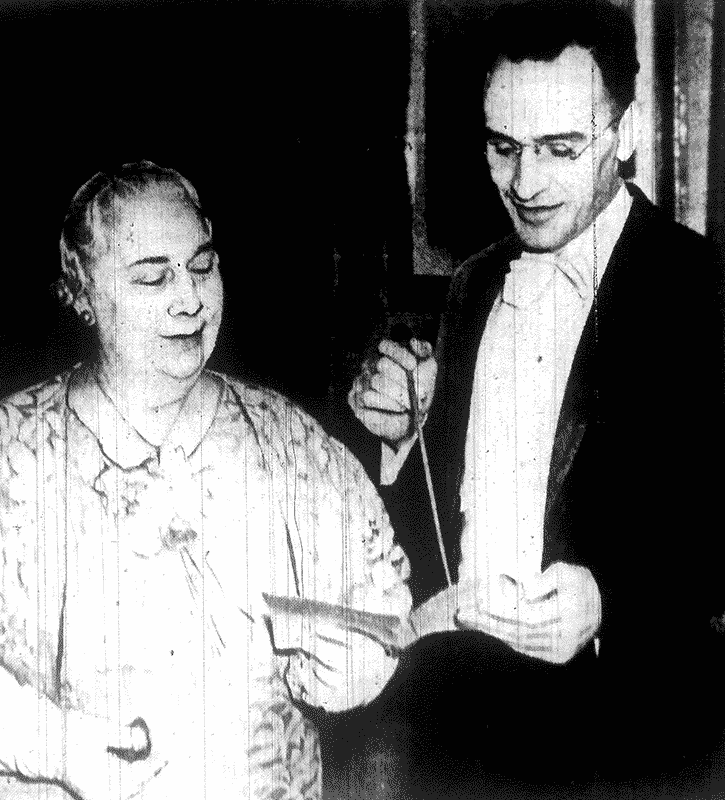 A native of Clackmannanshire, Scotland, Peter Allan (dates unknown) was a noted band leader in the Windsor area in the 1940s and 1950s. Born into a family of musicians, he studied trumpet in Scotland. He founded several bands varied in musicianship and purpose, including a band for unemployed men which became the Knights Templar Band and assisted with the 21st Essex Fusiliers Regimental Band and the Essex-Kent Scottish Pipes and Drums. He also composed music for bands, some of which was published. According to an audio interview of Windsor musician Celia Hardcastle in 1980, Allan formed a string quartet that played to great acclaim in the surrounding region, but was little-known in Windsor. Allan also formed a group of musicians from his band and string quartet that became the nucleus of the orchestra in a 1938 concert. Some time after that, Peter Allan left Windsor to return to Scotland.
Ernest Rennie (ca 1930-1950)
Ernest Rennie was a popular figure in Windsor and Chatham’s music industry throughout the 1930s and War years. He ran a music shop and repaired instruments, but loved to bring musicians together to play for a good cause. He assembled an orchestra for Sunday night concerts at the Tivoli Theatre on Wyandotte Street in Windsor to raise funds to send care packages to troops overseas. Their repertoire mainly consisted of popular songs and light classics. The group once attempted to learn to play Rachmaninoff’s Peter and the Wolf, but in 1940, it wasn’t quite up to the challenge. According to Hardcastle, the orchestra comprised of thirty musicians who appreciated Rennie’s talents, which was little acknowledged in the wider community. (Hardcastle, p. 57). Sadly, Rennie was involved in a serious car accident, and a back injury stopped his conducting.
Matti Holli (1947-1977)
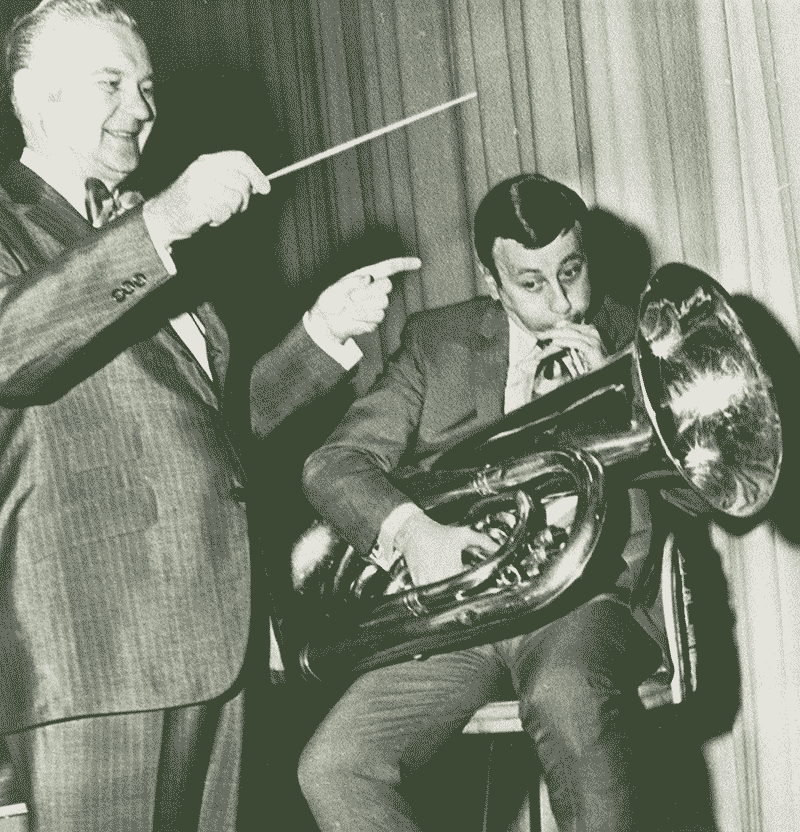 From a child musical prodigy to the Windsor Symphony Orchestra’s longest-serving conductor and music director, Matti Holli (1916-1977) is a key figure in its history. Born in Finland, Holli showed early promise by the time his family immigrated to Windsor in 1923. Holli studied musical theory, violin and piano at the Ursuline School of Music on Ouellette Ave. As a Grade 6 student, formed a small orchestra at the Ursuline School, as well as at his day school, Ada C. Richards School. At 16, he received the A.R.C.T. teacher’s certificate from Toronto’s Royal Conservatory. As a teenager, he was able to work as a jobbing musician both at the local radio stations, CKLW and CBE Windsor and in the summers at the Bob-Lo Island amusement park dance hall. He was multi-talented, and played violin, drums and brass as needed.
Holli continued his music education nearby at the distinguished Detroit Conservatory of Music, where he earned his Bachelor and Master of Music Degrees. He was an effective multi-tasker who also ran a musicians booking agency and ran at least two different dance bands, sometimes more. Holli played violin with Ernest Rennie’s group, and when Rennie could no longer conduct, Holli took over as leader of the group in 1946. As a long-term member of the local musicians union, he renamed the orchestra the Windsor Federation of Musicians Symphony Orchestra.
As well as his musical talent, Holli was an effective leader, teacher, mentor and administrator. He was able to persuade the Windsor city councillors to give the orchestra a grant, and shepherded the group to incorporation in 1947. Holli established the WSO’s first office at the Norton Palmer Hotel in downtown Windsor and helped to found the Windsor Symphony Society. In 1952, Holli co-founded a community orchestra in Wallaceburg, and conducted that orchestra for several years. He also established the Windsor Junior Symphony in 1957, and this became the International Youth Symphony.
Always proud of his Finnish heritage, Holli was devoted to the music of Finnish composer Jean Sibelius, whom he was able to visit in Finland in 1953. Holli was honoured to take part in a conductors’ exchange with a Finnish orchestra.
Some critics suggested that Holli’s tenure at the WSO was too long, and as the WSO celebrated its 25th anniversary, it was suggested that fresh leadership was needed. However, Holli’s dedication to his work with the WSO was evident through the years. Holli died unexpectedly of a heart condition on November 11, 1977, hours before he was to conduct a concert featuring the very young local violinist Lara St. John. Known locally as a “gentle giant” with his trademark bow tie, Holli’s efforts on behalf of the cultural life of Windsor were appreciated by musicians and the public.
Clifford Evens (1977-1979)
Clifford Evens (1921-1980) performed double duty as the conductor of the London Symphony Orchestra (London, ON), and as interim conductor and advisor to the board of the WSO after Matti Holli’s death. He was able to help the board with programming, even adjusting the lineup of music during the season in order to increase audiences and advising on guest musicians and conductors. Evens applied for the permanent post at the WSO, but the Board selected Laszlo Gati as the next conductor.
Laszlo Gati (1979 – 1985)
Matti Holli’s sudden death left a void of leadership with the WSO and a search was undertaken for a new conductor. A few guest conductors carried on the 1977-78 season, including a conductor with the Victoria Symphony Orchestra, Laszlo Gati (1925-), who performed with Canadian opera star Maureen Forrester. Gati was born in Romania, and his family moved to Hungary when he was young. Gati studied violin and viola and was an accomplished soloist in these instruments.
Laszlo Gati had conducted the State Philharmonic Society of Hungary and was also head of symphonic and musical programming at Hungarian Radio in Budapest. Immigrating to Canada in 1957, Gati founded the Montreal Chamber Orchestra in 1959, and had conducted the Victoria Symphony Orchestra in British Columbia for 11 years before coming to Windsor.
Laszlo Gati was a proponent of the educational work of an orchestra. George S. Gall, then Area Superintendent of the Windsor Board of Education endorsed Gati’s work: “Maestro Gati’s infectious enthusiasm and his obvious love of young people provided the ingredients for a musical experience that was most exciting and enjoyable” (November 16, 1979).
He sought to expand the professional repertoire with a 1979-80 season which was rich in music from Slavic composers and challenging classics. It was his dream to transform the WSO as a “corporate orchestra,” relying on corporate sponsors and service clubs to underwrite concerts. Gati also developed the idea of sending smaller ensembles made up of WSO members to play in local factories and work spaces in partnership with local industry. Ill health caused Gati’s early retirement from the WSO in 1985.
Timothy Vernon (1985-1986)
Timothy Vernon (1948-) performed as the Acting Conductor and Music Director for the Windsor Symphony Orchestra. From British Columbia, Vernon studied piano and cello and as a teenager, was an organist for several Anglican churches in the area. He conducted his graduate studies in Vienna. Vernon was music director of the Canadian Opera Company’s touring company at the time, and joined the music faculty at McGill University the same year he assisted the WSO after Laszlo Gati retired.
Dwight Bennett (1986-1990)
Dwight Bennett (1945-) was the Windsor Symphony Orchestra’s first Canadian conductor. Having studied music at the University of Toronto, Bennett won numerous awards in his field. With experience conducting the Thunder Bay Symphony Orchestra, he was also an instructor at Lakehead University. Bennett was a proponent of youth orchestras and he was co-founder and Music Director of the Thunder Bay Summer Music Camp. Bennett has an extensive background in operatic conducting, including the Canadian Opera Company and he had recorded Canadian works for CBC with the Winnipeg Symphony Orchestra.
When appointed to the Windsor Symphony Orchestra in 1986, Bennett also conducted the Thunder Bay Symphony for an additional two years. He had an ambitious mandate for the Windsor Symphony Orchestra, which included employing only professional musicians, and increasing the number of core musicians from 10 to 20. He increased the number of performances, and even took the WSO on a tour. Unfortunately, these plans coincided with an economic downturn in the Windsor community. Bennett left the WSO in 1990. The orchestra is still comprised entirely of professional musicians.
Susan Haig (1991-2001)
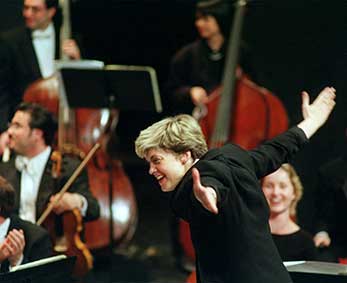 In its 1990 search for a new conductor, WSO manager Mina Grossman-Ianni spoke of a desire to take the Windsor Symphony Orchestra in a new, audience-driven direction, with a style of conducting and presentation that encouraged conductors to turn towards the audience to talk about the musical works and the orchestra.
Susan Haig, (1954- ) an energetic conductor from New Jersey was educated in liberal arts at Princeton University, holding Masters and Ph.D. degrees from Stony Brook University. Prior to joining the Windsor Symphony Orchestra in 1991, she was the popular associate conductor at the Calgary Philharmonic Orchestra, working with Mario Bernardi. She also studied the viola, and her degrees are held in music, theory, composition and orchestral conducting.
Haig guest-conducted a WSO classics concert in October, 1990 and was the first woman conductor to do so. She joined the WSO in 1991 as conductor, and then her title was changed to music director. Haig took a collaborative approach to conducting as both guest and incumbent, stating that “learning to rehearse well” is important: “The error usually [for a conductor] is talking too much. The players are so capable that they just need a clear physical signal. …To have [a conductor] stoop and say, ‘no, I would like it to go this way’ is so annoying, because then you feel like you’re … doing this person on the podium the favour of playing it the way they want, as opposed to doing what the music demands.” (Globe and Mail, November 30, 1991). Haig studied with Toronto dancer/choreographer Paula Thomson to improve her conducting skills, and continually studies languages in order to interpret music more fully, especially opera music.
One of the highlights of Haig’s debut season with the WSO was a performance of Beethoven’s Ninth Symphony coordinating several choral groups with the orchestra: the Elmer Isler Singers, the Windsor Symphony Chorus and the Windsor Classic Chorale. “When the last notes … thundered … someone in the balcony leapt to his feet and cried out, not the standard and accepted ‘Bravo!’ but ‘Wow!’” (Gervais, November 11, 1991).
Susan Haig, although American by birth, is a proponent of new Canadian orchestral music and founded the Windsor Canadian Music Festival in 1997, which took place annually until 2011 with the cooperation of the WSO and University School of Music (see also Composers). Haig was committed to bringing the live orchestral experience to the community in small intimate concerts as well as at the large Chrysler Theatre, and engaging with the audience, including at the Art Gallery of Windsor. Haig remained with the WSO until the 2000-2001 season to conduct the South Dakota Symphony Orchestra and work on other projects.
John Morris Russell (2001-2012)
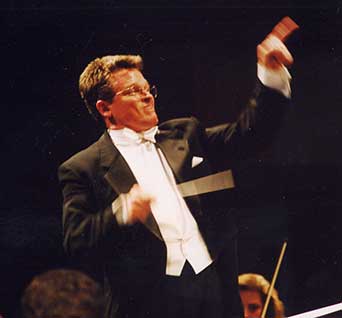 John Morris Russell (1960 – ) joined the Windsor Symphony Orchestra as it continued its journey to the cultural heart of the community that had begun with Susan Haig and her predecessors. A well-respected pops conductor from the USA, Russell has distinguished himself with more classical fare as well.
Born in Cleveland, OH, Russell was an enthusiastic music student in school, playing trumpet and appreciating all forms of music from Motown to Mozart. He holds a Bachelor of Arts degree from Williams College in Massachusetts and a Master of Music degree in conducting from the University of Southern California. He has studied widely in London at the Guildhall School of Music and Drama, for example and the Pierre Monteaux School for Conductors in Maine.
During his tenure at the WSO, Russell worked to de-mystify the role of a conductor and orchestra in the community. Like Haig, and even Holli before him, he engaged local musicians and performers, adults and children in concerts as performers. He held conducting workshops for musicians, music teachers and students. Working with the youth of Windsor-Essex was a priority for Russell, and he reignited Windsor’s heritage of youth orchestras by coordinating the Windsor Symphony Youth Orchestra with WSO’s Assistant Conductor, Peter Wiebe in 2004. A lasting legacy of this emphasis on music for children is the 2008 Juno-nominated CD recording of Peter and the Wolf & Last-Minute Lulu. Russell could often be found in area schools, meeting with students, and even allowed students to watch dress rehearsals of certain concerts.
Russell also raised the profile of the WSO with frequent orchestra performances on CBC radio and television including a CBC-TV special, “Opening Night” which also won an award. Those efforts helped to inspire a downtown urban renewal for the cultural sector.
Russell’s success in reaching out to the youth and families of Windsor Essex has paid dividends with a younger demographic now attending concerts. In recognition of his efforts, Russell was named the Windsor Symphony Orchestra’s first Conductor Laureate in 2011 when he returned to Cincinnati as Pops Conductor, and he has advised the WSO administration on the 2012-13 Season search for a new conductor.
Robert Franz (2013 – )
After a year-long search for a new candidate, Robert Franz was selected from among a field of over 150 applicants. Franz, (1969- ) was born in Kingston, New York, and initially trained as an oboe player. He studied music at the North Carolina School of the Arts, receiving his Bachelor of Music in Oboe performance in 1990 and his Master of Music degree in conducting in 1992. He furthered his education at conducting workshops in the Czech Republic, St. Petersburg (Russia), Nashville, TN, and took part in the 1997 Conductor Preview.
Franz is known for supporting new music by contemporary composers, overseeing composer-in-residence programs at the Boise Philharmonic, and has worked with Pulitzer-Prize winning composer Jennifer Higdon and others such as Jake Heggie and Shulamit Ran. Franz is an enthusiastic promoter of music education and under his supervision, both the Buffalo Philharmonic Orchestra and the Louisville Orchestra have been awarded the Leonard Bernstein Award for Educational Programming.
Franz is also an accomplished writer, and produces a regular blog, Building Bridges with Music, which offers insights into the musical and education process through his work. He has also written a book for children, Stella’s Magical Musical Tour of America, which is packaged with a CD and is intended for use with children’s symphony programs. Stella tells the story of a young girl’s adventure in a hot air balloon, and incorporates musical elements throughout the journey.
Robert Franz is the WSO’s new music director, as of July, 2013. He is also the Music Director of the Boise Philharmonic, Associate Conductor of the Houston Symphony, and Music Director of the Fairbanks Summer Arts Festival Opera and Orchestra in Alaska.